
Rising fuel prices have put electric vehicles back on the agenda for company fleets, but the framing is different from 2022. Back then the question was when prices would return to normal. Now it is what a fleet pays if diesel stays volatile for years. Read together, three pieces of news from the past week carry a clear message for fleet managers and finance leads.
What happened in one week
On October 2 the G7 announced that it will release 100 million barrels of crude oil and diesel from strategic reserves over four months through the International Energy Agency, with diesel prioritised in the first 20 days. That is not a sign of calm. Reserves get opened when the market no longer sorts out supply on its own, and winter is still ahead.
On September 28 Transport & Environment published its total cost of ownership analysis for electric trucks across nine EU member states. According to T&E's model, an electric heavy truck is already cheaper than diesel over its lifetime in six of the nine markets, and those six account for 46 percent of new heavy truck sales in the EU. Over five years the model puts the saving at roughly 85,000 euros per vehicle in Germany and 100,000 euros in the Netherlands, rising to 106,000 euros in Germany under a diesel price shock scenario. An important caveat: these are T&E's own model estimates built on assumed energy prices, tolls and subsidies, not measured fleet data. Payback is put at two years in the Netherlands, Germany and Denmark.
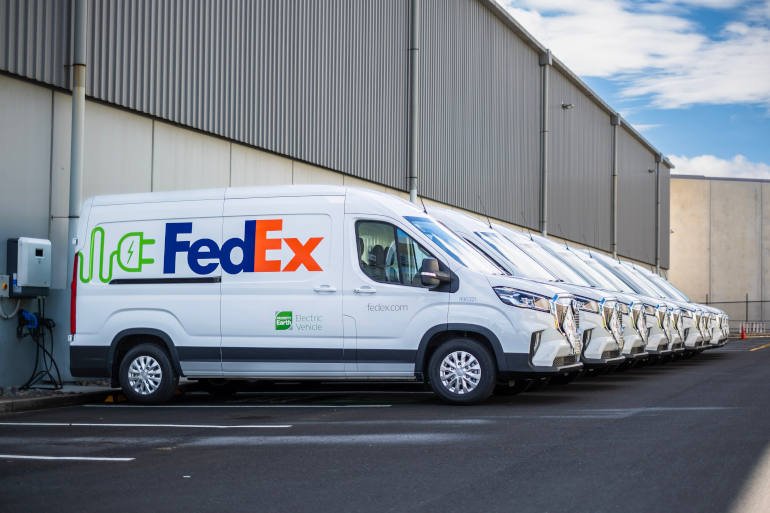
On September 30 FedEx ordered 2,000 electric trucks from Harbinger, a deal worth more than 300 million dollars with delivery by the end of 2027. Harbinger estimates that each vehicle saves around 20,000 dollars a year in fuel compared with the diesel truck it replaces. This is no longer a pilot but a fleet-level decision, and FedEx had been running these vehicles since 2025 before committing to a volume of this size.
The same day Workhorse announced that Gateway Fleets had ordered a further 200 W56 electric step vans on top of the 100 placed earlier this year. Gateway's model is built for smaller delivery contractors: vehicle, charging, depot access and financing come as one leased package, so the operator meets a monthly cost first rather than a purchase price and a charger investment.
Why this is different from 2022
Three things have changed. The supply and pricing of electric commercial vehicles now make a two-year payback a normal result in the models rather than an outlier. Bundled offers have appeared that take the biggest barrier, upfront capital, off the fleet. And diesel is no longer showing a one-off spike but sustained geopolitical uncertainty, which the G7 move confirms more than it dispels.
What has not changed: the decision should not be made on the numbers in the articles. T&E's model works with national averages, Harbinger's estimate with US diesel and electricity prices. A Hungarian or Central European fleet operates with different tolls, a different electricity price and a different subsidy environment. The lesson is not that the saving is 85,000 euros. The lesson is that the question is no longer the technology, it is your own calculation.
Where to start
If you are responsible for the fleet of a mid-sized company, or you sit on the finance side, this is the order I would follow:
- Map the routes. Which vehicles return to the same depot every evening, and what is their daily mileage? These are the simplest to charge and carry the highest diesel exposure per kilometre.
- Your own TCO, your own scenarios. Run three diesel prices: today's, the 2022 peak and a level in between. Add your own electricity price, tolls and maintenance costs. If the model tips to electric in two of the three scenarios, you have a basis for a decision.
- Charge at the depot, not on the road. Public fast charging is expensive and unpredictable. Depot charging is a fixed cost you can plan, and grid capacity needs to be clarified with the utility early.
- Bundled offer or own investment. The Gateway logic is spreading in Europe too: vehicle, charger and financing in one contract. It is worth requesting at least one such offer as a benchmark, even if you end up investing yourself.
- A pilot of 3 to 5 vehicles with measurable targets. You are not testing the technology, FedEx has done that. You are measuring your own routes, driver acceptance and real consumption so that the bigger decision rests on your own data.
Rising diesel prices are unpleasant, but they also provide a clean test: they show which fleets calculated ahead and which react afterwards. Whoever does the maths now will not be reading the news at the next price shock. They will be reading their own spreadsheet.